Sports Medicine · Applications

Return to play, backed by data.

The athlete is asking, the coach is asking, and the call is yours. Baliston Health gives sports medicine teams objective movement data for return-to-play decisions — captured in the same gait, run and hop protocols you already use.

Return-to-play workflows
Walk, run and jump protocols
CE & FDA cleared
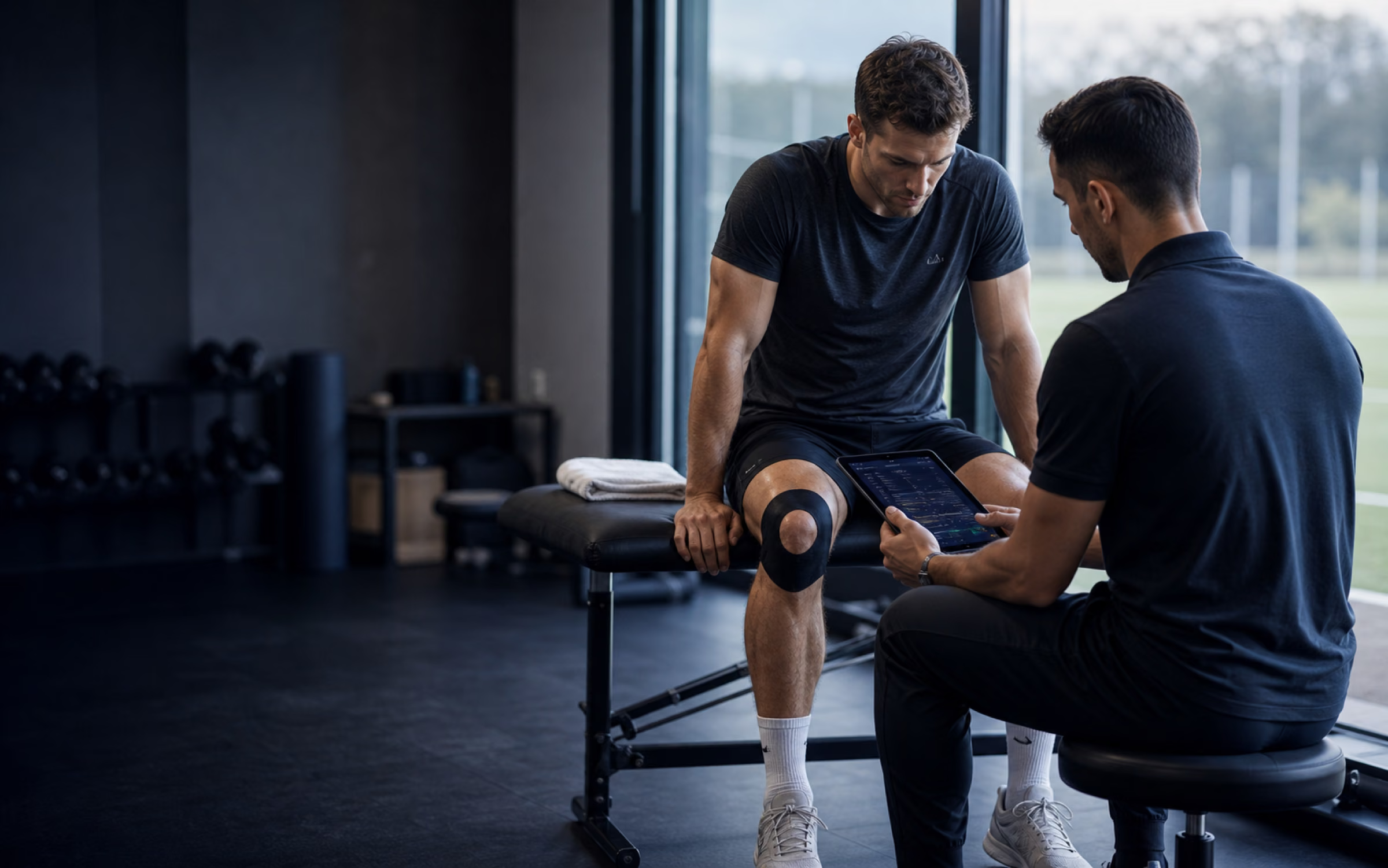
Sports clinician reviewing return-to-play data with an athlete
3 minMovement capture
30+Biomechanical parameters
Bal AIDecision-support layer
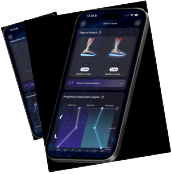
What Baliston does for sports medicine

Four jobs you do every week. Sharper, faster, more defensible.

Across every athlete encounter — acute injury triage, rehab progression, return-to-play clearance, and re-injury risk screening — the underlying clinical work is the same. The platform gives you measurable, repeatable, comparable movement data for the decisions that need to stand up later.

Use

A full assessment in three minutes — inside the workflow you already run.

Baliston Health fits the sports medicine visit: insert the AI Mov-Scan insole, run the relevant gait, run or hop protocol, and use Bal AI to surface the movement patterns worth clinical review.

Step 01 · Insert

Insert the connected insole.

The AI Mov-Scan insole goes into the athlete's own shoe. No setup, no calibration, no markers. The assessment stays inside the visit rather than becoming a separate lab appointment.

Step 02 · Walk · Run · Jump

Run the protocol that matches the question.

Walk for baseline, run for sport-specific mechanics, hop or jump for power and landing control. AI Mov-Scan captures continuously while Bal AI translates movement into reviewable signal.

Step 03 · Read

Read what the data — and Bal AI — surfaces.

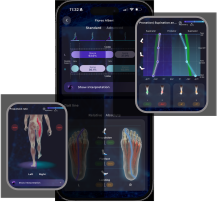
30+ biomechanical parameters, structured into a visual report. Bal AI compares the session to the athlete's history and surfaces the return-to-play signals for you to interpret, validate and document.

2,000/secMotion samples
30+Validated parameters
<3 minPer assessment
95%Agreement vs. optical motion capture (peer-reviewed, Sensors)
Sports Medicine Cases

Five high-stakes RTP moments. Five real Bal AI conversations.

Click any card to see how Bal AI supports a return-to-play decision — a clinical question, a data-backed answer, and documentation the clinician still owns.

Analyses

Walk · Run · Jump.
The protocols sports medicine already trusts — instrumented.

Every Baliston Health deployment runs the same software platform. For sports medicine, Walk creates the recovery baseline, Run captures mechanics under sport demand, and Jump supports return-to-play decisions when landing, power and asymmetry matter most.

Run analysis app interface
Card 1 · Run
Run
Best for

Stride mechanics review, running efficiency analysis, in-season load monitoring, and return-to-play assessment for runners.

What it captures
  • Stride symmetry and cadence consistency at running pace
  • Propulsion and contact-time analysis under impact
  • Landing mechanics and shock absorption
  • Pre-fatigue vs. post-fatigue comparison
  • Running-specific asymmetries that hide at walking pace
Why it matters

Running pace reveals deficits that can disappear in walking: altered cadence, contact-time changes, propulsion loss and landing-impact asymmetries that shape return-to-sprint decisions.

Add-on for the AI Mov-Scan Kit · Included with Gait Lab Mini and Gait Lab
Jump analysis app interface
Card 2 · Jump
Jump
Best for

ACL and lower-limb return-to-play testing, hop-distance confirmation, landing-control review, asymmetry surveillance under maximum effort.

What it captures
  • Counter Movement Jump — explosive lower-limb power
  • Single Hop Test — unilateral power and landing control
  • Triple Hop Test — fatigue-resistance and asymmetry under load
  • Side Hop Test — frontal-plane stability and reactive control
Why it matters

A passing distance score does not always mean a passing landing strategy. Jump testing surfaces asymmetry, contact instability and fatigue effects that can stay hidden in static testing.

Add-on for the AI Mov-Scan Kit · Included with Gait Lab Mini and Gait Lab
Walk analysis app interface
Card 3 · Walk
Walk
Best for

Early rehab baseline, longitudinal recovery tracking, gait quality review, low-intensity readiness checks, and comparison to the athlete's own pre-injury record.

What it captures
  • Limb loading distribution and symmetry
  • Stance time, swing time, cadence
  • Foot dynamics, strike pattern, contact stability
  • Stride quality index
  • Propulsion symmetry
Who uses it most

Used most heavily when the athlete is not ready for running or jumping yet — the foundation for the record that follows them into higher-load protocols.

Included with every deployment

Most sports medicine teams start with Walk and add Run and Jump as return-to-play decisions become more demanding. Talk to sales →

Evidence & Adoption

Built for sports medicine teams who need clearance decisions to be defensible.

Sports physios, team clinicians and rehab specialists use the platform to support assessment, rehab progression, return-to-play decisions and the records that travel with the athlete.

30+
Parameters per sports medicine assessment
4
Jump protocols covering lower-limb RTP scenarios

Baliston gives sports medicine teams a clearer way to document return-to-play. The value is not that the system clears the athlete — it surfaces the movement evidence we need to make and defend the call.

Sports medicine lead
Rehabilitation and sports medicine clinic · Baliston partner program
Trusted by sports medicine clinics, teams, athletic departments, and rehab programs

See it on a real RTP case.

The fastest way to evaluate Baliston Health is to see it run on a return-to-play decision your team already makes every week.

Book a demo
30 minutes. Three real sports medicine cases.

We'll walk you through three RTP cases — including one where dynamic data changed the clearance conversation.

Book the demo
Talk to sales
Clinic, academy, team, or institution.

For sports medicine clinics, academy systems, team deployments, or university athletic departments — let's start with a conversation.

Talk to sales
Download the sports medicine brief