Performance & Conditioning · Applications

Train the engine, not the output.

Strength tests pass. Athletes still break down. The platform gives you the dynamic data behind the numbers — what's actually changing under load, what's recovering, what's not — so you can adjust training before the athlete tells you something's wrong.

Training facilities using Baliston
Walk, Run, and 4 jump protocols
Built for daily training environments
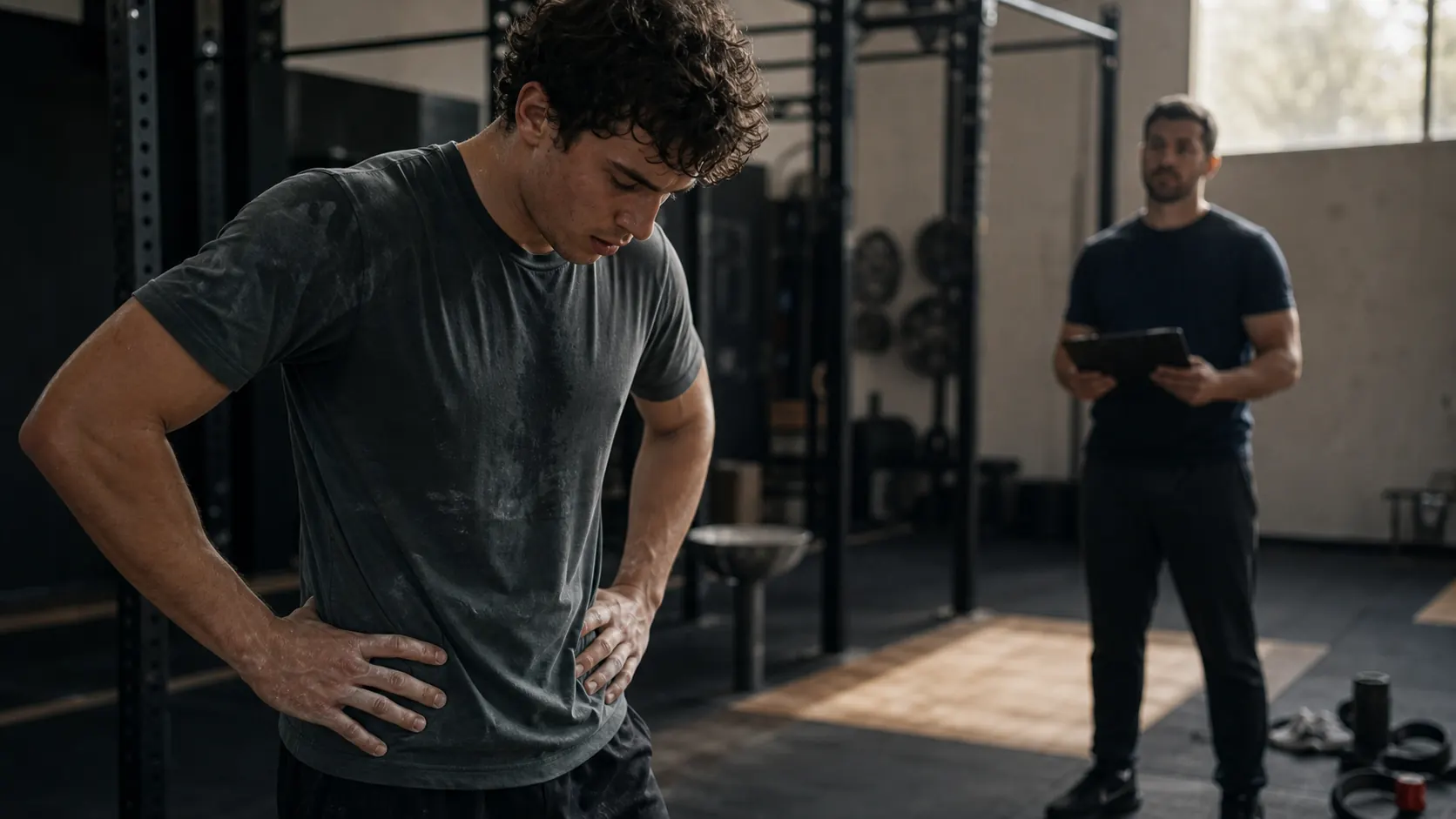
Athlete recovering at the end of a training session while a coach observes
30+Parameters per session
<3 minPer assessment
4Validated jump protocols
What Baliston does for performance staff

Four jobs you do every week. Sharper, faster, more defensible.

Across every athlete encounter — pre-season screening, daily readiness check, return-to-training handoff, in-season monitoring — the underlying work is the same. The platform gives you measurable, repeatable, comparable data for every decision that affects training load.

Use

A full assessment in three minutes — no extra staff, no special protocol.

The platform is designed to fit how a training session actually works — between the warm-up and the workout, or between the session and the cooldown. Athletes assess in their own training shoes, on the gym floor or pitch they already train on. No setup, no calibration, no learning curve.

Step 01 · Insert

Insert the connected insole.

The AI Mov-Scan insole goes into the athlete's normal training shoe. No setup, no calibration, no markers. The athlete stays in the same footwear they trained in yesterday and will train in tomorrow.

Step 02 · Walk · Run · Jump

Three minutes of movement.

The athlete moves naturally — walking for baseline, running for stride symmetry and propulsion, hopping or jumping for explosive power and landing control. AI Mov-Scan captures motion continuously while Bal AI translates it into actionable signal.

Step 03 · Read

Read what the data — and Bal AI — surfaces.

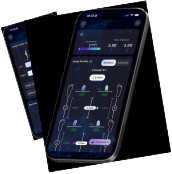
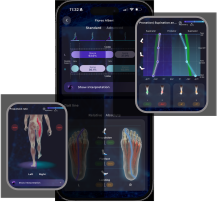
30+ biomechanical parameters across all three movement types, structured into a visual report. Bal AI compares the new session to the athlete's baseline, prior sessions, and squad norms — surfacing the readiness signals that affect today's training decision.

2,000/secMotion samples
30+Validated parameters
<3 minPer assessment
95%Agreement vs. optical motion capture (peer-reviewed, Sensors)
Performance Cases

Six common performance scenarios. Six real Bal AI conversations.

Click any card to see how Bal AI handles a scenario you face regularly — a real question, a real answer, in seconds. Same platform, same reasoning, scripted from real Baliston Health output.

Analyses

Run · Jump · Walk.
For performance work, Run and Jump do the heaviest lifting.

Every Baliston Health deployment runs the same software platform — but for performance and conditioning, the analyses you'll actually use are concentrated where training intensity lives. Run captures stride mechanics under load. Jump is where readiness, fatigue resistance, and asymmetry under maximum effort are measured. Walk gives you recovery baseline and longitudinal tracking.

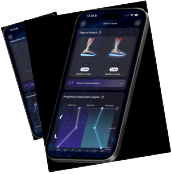
Run analysis app interface
Card 1 · Run
Run
Best for

Stride mechanics review, running efficiency analysis, in-season load monitoring, return-to-training assessment for runners.

What it captures
  • Stride symmetry and cadence consistency at running pace
  • Propulsion and contact-time analysis under impact
  • Landing mechanics and shock absorption
  • Pre-fatigue vs. post-fatigue comparison
  • Running-specific asymmetries that hide at walking pace
Why it matters

Most performance gains and losses happen at running pace, not walking pace. Cadence shifts, contact time changes, and landing-impact asymmetries distinguish efficient training from breakdown training.

Add-on for the AI Mov-Scan Kit · Included with Gait Lab Mini and Gait Lab
Jump analysis app interface
Card 2 · Jump
Jump
Best for

Readiness checks, pre-season screening, in-season fatigue monitoring, return-to-training progression, asymmetry surveillance under maximum effort.

What it captures
  • Counter Movement Jump — explosive lower-limb power
  • Single Hop Test — unilateral power and landing control
  • Triple Hop Test — fatigue-resistance and asymmetry under load
  • Side Hop Test — frontal-plane stability and reactive control
Why it matters

A passing strength test on the rack doesn't mean a passing performance under load. Jump testing surfaces asymmetries and instabilities that only appear at maximum effort.

Add-on for the AI Mov-Scan Kit · Included with Gait Lab Mini and Gait Lab
Walk analysis app interface
Card 3 · Walk
Walk
Best for

Recovery baseline assessment, longitudinal tracking across seasons, return-to-walk milestones in early return-to-training, low-intensity readiness checks.

What it captures
  • Limb loading distribution and symmetry
  • Stance time, swing time, cadence
  • Foot dynamics, strike pattern, contact stability
  • Stride quality index
  • Propulsion symmetry
Who uses it most

Used most heavily in recovery contexts — morning readiness, post-match assessment, early-stage return-to-training, and longitudinal records across seasons.

Included with every deployment

Most performance facilities benefit most from the Gait Lab Mini or Gait Lab. Run and Jump are core for performance work — and both come included in the kiosk and station tiers. Talk to sales →

Evidence & Adoption

Used by performance staff who decided eye-test and stopwatch weren't enough.

Training facilities, athletic departments, and performance gyms use the platform in daily training environments — for screening, readiness, return-to-training, and the longitudinal records that travel with their athletes.

30+
Parameters per performance assessment
4
Validated jump protocols covering RTP and readiness scenarios

Baliston gives performance staff a clearer way to see what the eye-test misses. The value is not another score — it's knowing when to push, hold, or change the block.

Performance director
Training facility · Baliston partner program
Trusted by performance facilities, teams, athletic departments, and training groups

See it on a real performance case.

The fastest way to evaluate Baliston Health is to see it run on an athlete who already trains in your environment.

Book a demo
30 minutes. Three real performance cases.

We'll walk you through three real cases — including one where dynamic data caught a deficit before strength testing or the eye-test would have.

Book the demo
Talk to sales
Multi-team, league, or performance group.

For multi-team contracts, league-level deployments, university athletic departments, or performance facility partnerships — let's start with a conversation.

Talk to sales
Download the performance brief